The calendar invite said: Team brainstorm. Bring your ideas.
Tuesday morning, an hour before the meeting, you are still working on something else. You open Claude. “Brainstorm five ideas for the Q3 campaign. Put them into a slide deck.” Twelve seconds later, you have five ideas across three slides. You skim them. You change one word. You walk into the conference room.
One by one, your colleagues present.
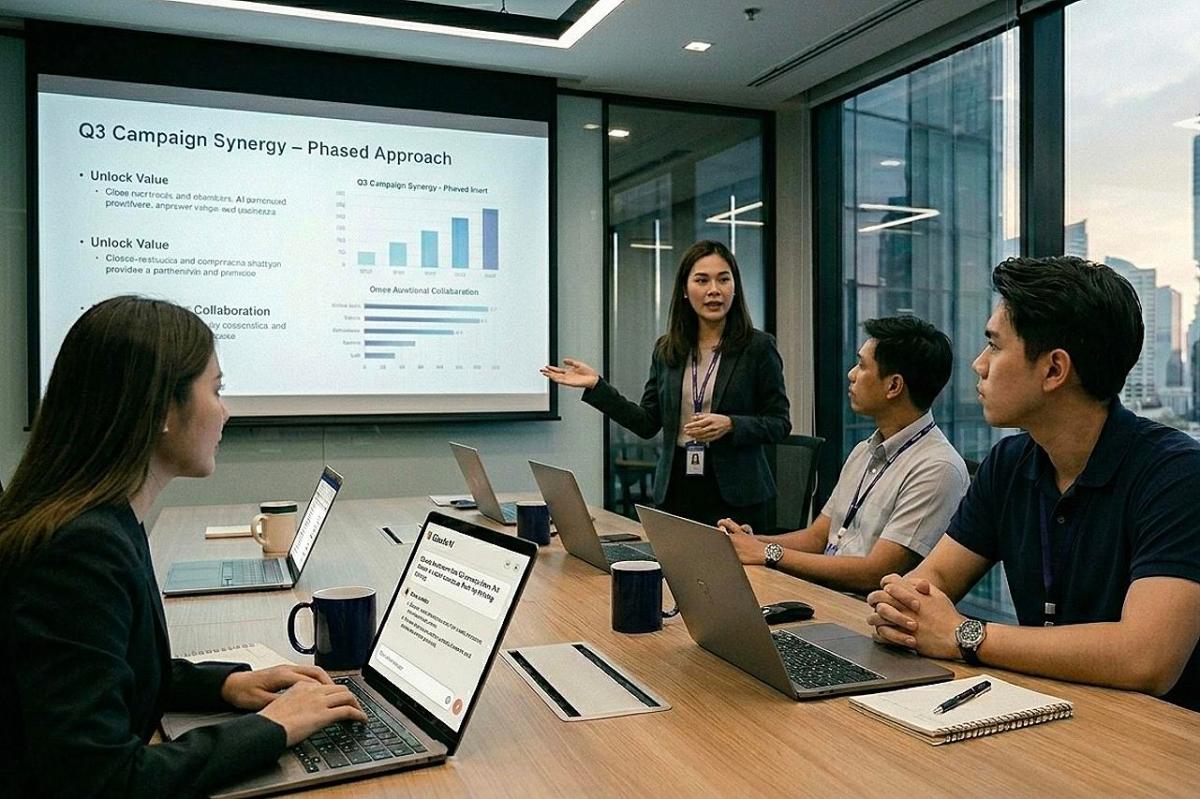
The first deck has three perfectly balanced columns proposing cross-functional synergies. The second, also three columns, suggests exploring untapped customer segments. The third, also three columns, proposes a phased approach to digital transformation.
The slides are clean. The spacing is suspiciously perfect. The ideas are all reasonable. Nobody disagrees with anything.
Halfway through, you notice something. Nobody has a strong opinion. Nobody is fighting for their idea. Nobody is saying “I really think we should do this, and here is why.” The ideas are reasonable, but no one in the room seems to actually believe in any of them. The room has a strange, smooth cohesion to it, not the cohesion of people thinking the same way, but of people having asked the same tool the same kind of question.
The meeting ends. “Great session,” someone says. Nothing has been decided.
Welcome to the age of workslop.
In September 2025, researchers at the Stanford Social Media Lab and BetterUp Labs published a study in the Harvard Business Review that gave a name to something millions of office workers had been quietly drowning in. Workslop: AI-generated work content that masquerades as good work, but lacks the substance to meaningfully advance a given task.
It looks professional. It uses the right words. But under any real scrutiny, the substance falls apart. The deck that says nothing. The memo that summarizes nothing in particular. The “recommendation” that is actually a list of considerations handed back to whoever asked.
In a survey of 1,150 US desk workers, 40 percent said they had received workslop in the past month. Each instance took nearly two hours to resolve. The researchers estimated the cost at 186 dollars per employee per month, or nine million dollars a year for a 10,000-person company.
The more striking finding was this. People who received workslop reported viewing the sender as less reliable, less creative, and less trustworthy. There is a quiet trust penalty for using AI carelessly, and it accrues even when no one says anything out loud.
The promise of AI was that it would free humans to do more meaningful work. Instead, AI made it cheap to produce, so we produce more. The output goes up. The actual thinking goes down. The sender saves fifteen minutes. The receiver loses two hours figuring out what it is trying to say. The work did not disappear. It got transferred from the person who should have done the thinking, to the person who now has to clean up after them.
This is the paradox at the heart of the AI productivity story. Anyone can generate a polished slide deck in twelve seconds. What is scarce now is judgment. The ability to read a draft and say, this looks fine but it is empty, do it again. The willingness to plant a flag and say, this is what I think, and this is why.
These are deeply human skills. AI did not make them less important. It made them the most valuable skills in the room.
The answer is not to use AI less. Well-thought-out does not mean manual. The point of using AI well is to think harder, to use it as a thinking partner that pushes your ideas further, not as a substitute for thinking entirely.
At SCBX, as we move toward becoming an AI-first organization, this is the line we keep returning to. Being AI-first is not about producing more. It is about freeing our people to do the work only humans can do, which is judging, deciding, and being willing to say when something is not yet good enough. In an era where output is infinite, the scarcest resource is a human being willing to make a call.
Back to the Tuesday brainstorm. You walk back to your desk. You open Claude again. But this time, you do not ask it to generate something. You type in your own half-baked, slightly weird thought. The one you actually believe in but have not figured out how to say yet.
Push my thinking, you type. Tell me where this falls apart.
That is the moment AI gave you real productivity.
Writer: