
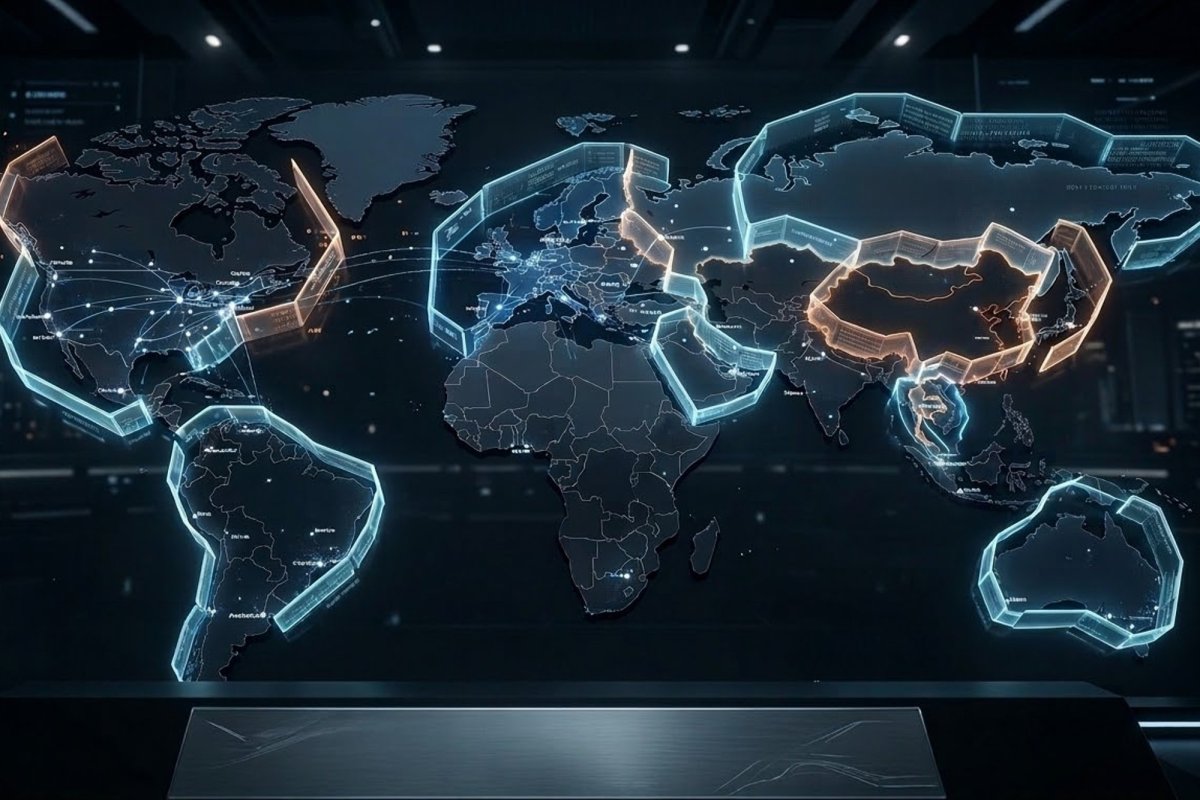
In recent months, a series of decisions have begun appearing across the world.
France has announced plans to phase out tools like Zoom and Microsoft Teams across government institutions as part of a broader push for digital autonomy, replacing them with a domestically developed platform. The Austrian Armed Forces have completed their transition from Microsoft Office to the open source LibreOffice suite, citing concerns over cloud telemetry and operational security. In Germany, the regional government of Schleswig-Holstein has moved 30,000 public sector employees away from Microsoft Exchange and Outlook to alternatives such as Open Xchange and Nextcloud.
Individually, these moves may seem minor. A change in software. A shift in office tools.
But together they reveal a larger pattern.
The internet was once imagined as a borderless world. Now borders are returning.
The story is not really about Zoom or Microsoft. It is about control of digital infrastructure.
For the past three decades, the world assumed technology infrastructure could be globalized. Countries relied on a small number of dominant platforms to power communication, data storage, productivity tools, and increasingly, artificial intelligence. It was convenient, efficient, and scalable. But it also created deep dependencies.
Today, governments are beginning to recognize that many of the digital systems their societies rely on are controlled by foreign companies and, ultimately, foreign governments. That realization is changing how nations think about technology.
What we are witnessing is the early stage of a new shift. A movement to bring critical digital infrastructure back under national control. This process could be described as geopatriation, the return of technological capability to the nation state.
This shift is closely tied to the rise of Sovereign AI and the broader idea of Digital Sovereignty. The logic is simple. If artificial intelligence becomes core infrastructure, countries may not want that intelligence to be entirely controlled elsewhere.
Recent geopolitical developments have accelerated this thinking. The US-China technology rivalry, sanctions that cut Russia off from global platforms, semiconductor export controls, and restrictions on advanced AI chips have all forced governments to reconsider their technological dependencies. Questions about where national data is stored and who controls the models behind modern AI systems have moved from technical debates to matters of national security.
Around the world, countries are beginning to respond. Europe is investing in sovereign digital infrastructure and supporting companies like Mistral AI to build European frontier models. The United Arab Emirates has developed Falcon, one of the world’s leading open weight large language models. India has built a national digital infrastructure through India Stack, powering digital identity and payments at a national scale. South Korea is developing domestic AI capabilities through systems like HyperCLOVA X, while Japan is investing in sovereign cloud infrastructure for government systems.
Technology, once viewed primarily as an economic tool, is increasingly seen as an instrument of national power. Governments are beginning to ask difficult questions. Who controls the AI models we rely on? Where is our national data stored? What happens if geopolitical tensions disrupt access to critical digital services?
For decades, globalization assumed technology platforms would remain politically neutral. That assumption is no longer taken for granted.
As a result, governments are investing in sovereign clouds, national AI models, domestic semiconductor capacity, and open source alternatives to widely used software. The internet is not disappearing, but it is slowly fragmenting into spheres of technological influence: American platforms, Chinese platforms, European platforms, national AI systems, and national data infrastructure.
The borderless internet is gradually evolving into a world of digital jurisdictions.
This raises an important question for countries like Thailand. What does technological sovereignty mean for us?
Thailand has benefited enormously from global technology platforms. Cloud infrastructure, digital tools, and AI models from international providers have accelerated innovation across industries. But as artificial intelligence becomes embedded in finance, healthcare, governance, and critical infrastructure, the question of sovereignty becomes more relevant.
Should key digital capabilities remain entirely dependent on foreign platforms? Or should countries develop at least some domestic capacity to understand and govern the technologies shaping their societies?
For financial institutions, this question carries particular weight. Finance runs on trust, data, and resilience. Artificial intelligence will soon power everything from fraud detection to credit decisions to financial advice.
Understanding how these systems work, where they are hosted, and how they can be governed responsibly will become a critical capability.
At SCBX, we are investing in frontier research partnerships and exploring areas such as responsible AI, the development of open language models including our own Typhoon, and the future infrastructure of financial intelligence. Not because every country must build everything alone, but because understanding the technologies shaping our future and our context is itself a form of sovereignty.
In the coming years, competition between nations may not only be about military power, natural resources, or economic size. It may increasingly be about something far less visible: control over the intelligence that powers the digital world.
Writer: