
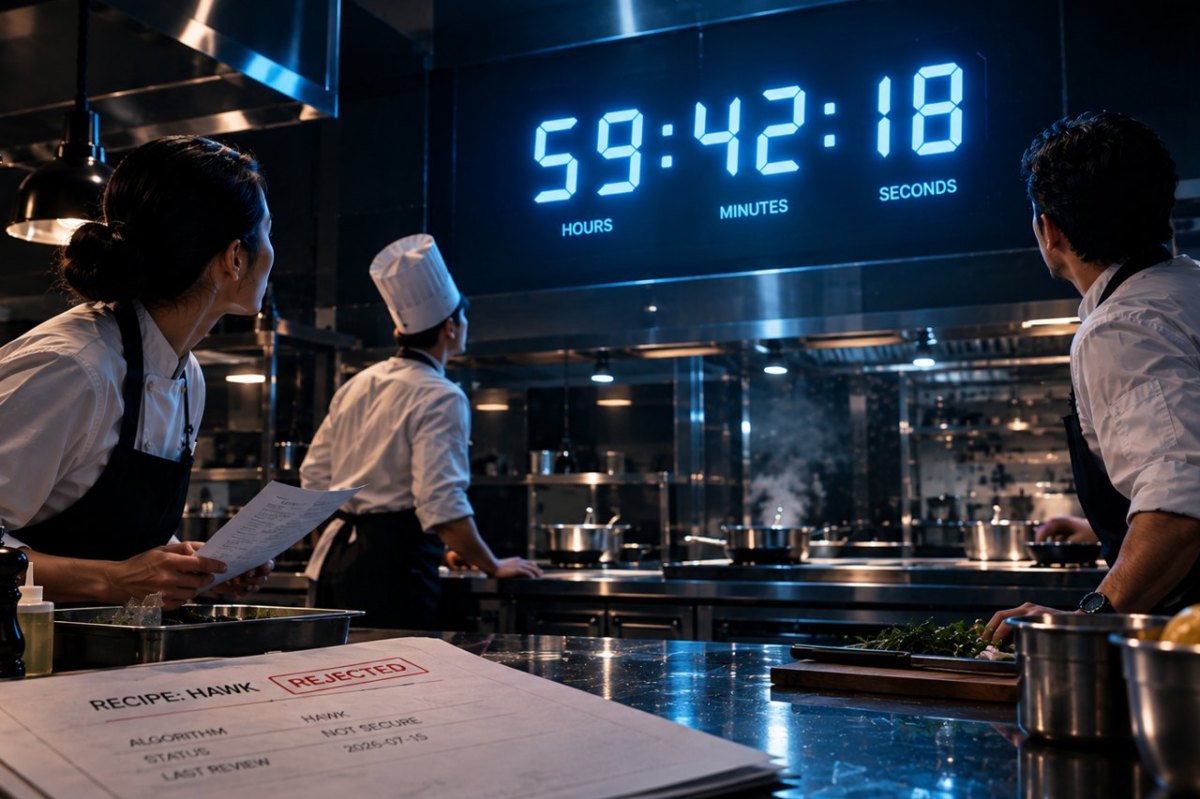
Imagine a restaurant that has served the same dish for thirty years.
It is the reason people come. Every table orders it. Every kitchen is built around it. The recipe has never changed because it has never needed to change.
Then, one Tuesday, everything changes. The head chef opens the newspaper and sees the recipe printed on the front page. Someone has cracked it. Everyone in the world now knows how to make it.
The restaurant has to change what it serves. But the whole restaurant was built around one dish.
The digital world is standing in a very similar restaurant right now.
For the last thirty years, almost every piece of digital information you rely on has been protected by a small number of encryption recipes. When you log in to your banking app, when a payment goes through, when a website shows a little padlock in your browser, one of these recipes is quietly running in the background, scrambling data so that only the right person can unscramble it. You never see them. But they are everywhere.
The problem is that recipes do not last forever. Sometimes mathematicians find a clever new way to break them. And sometimes, an entirely new kind of computer arrives and changes what is possible.
That last one is not hypothetical. It is called Quantum Computing.
A powerful enough quantum computer would be able to solve mathematical problems that are simply too hard for today’s machines to crack, including the ones that keep almost every digital transaction, medical record, and government message safe. The industry calls the day this becomes possible Q-Day. We do not know exactly when Q-Day will arrive, but the timeline is shortening every year.
Which brings us to a term you will hear more and more in the coming years. Crypto-Agility.
Crypto-Agility is the ability to change your encryption recipes quickly and safely, without breaking everything that depends on them. It is what separates the restaurant that can update its menu overnight from the restaurant that has to close for a year of renovations.
Here is why this matters now, not later. Even the new post-quantum recipes being developed today are not guaranteed to work forever. In July 2026, just months ago, an AI system was pointed at a promising post-quantum algorithm called HAWK. HAWK had survived two years of expert human review and was in the final rounds of being considered as a future standard. In roughly 60 hours, the AI found a mathematical flaw that human researchers had missed. Within 24 hours, HAWK’s developers withdrew it from consideration entirely. Even the algorithms the world is carefully evaluating as future replacements can now fail in a matter of days.
The organizations that will handle Q-Day well are not the ones with the best current encryption. They are the ones whose systems were designed to change encryption without disruption. Same restaurant. Different dish.
The competitive stakes are already clear. Imagine a world where global card networks like Mastercard and Visa quietly upgrade their payment infrastructure to be quantum-safe and fully Crypto-Agile. If a Thai bank has not done the same, its transactions become the weakest link in the chain. Corporate clients notice. Regulators notice. Customers eventually notice too. Being late is no longer a technology problem. It is a trust problem.
At SCBX, this is a question we take seriously. As one of Thailand’s largest financial groups, our systems process millions of transactions every day, each one protected by encryption that has to keep working, no matter what the next decade brings. Crypto-Agility is not just about being ready for quantum. It is about building the muscle to adapt to whatever comes after quantum, and whatever comes after that. It starts with knowing where our encryption lives across every part of our operations, and continues with designing our systems so we can change recipes without ever asking a customer to notice.
Back to the restaurant. The dish that made it famous will one day be a memory. The kitchen that survives is the one that already knows what to serve next.
That is what Crypto-Agility really is. Not a technology. Not a project. A quiet habit of readiness, learned long before it is needed. And in a world where the next recipe can fail in sixty hours, the organizations already practicing are the ones that will still be standing when the menu changes for good.
Writer: