AI Is Getting Cheaper. Transformation Isn’t.
Source: Session “Under the Iceberg: What AI Transformation Really Looks Like,” featuring Yupawadee Srisukvattananan, Head of AI Transformation, SCBX, and Dr. Tutanon Sinthuprasith, Head of R&D, SCBX, at Techsauce Global Summit 2026.

AI is getting smarter, faster, and cheaper to access every day. Frontier models that were once accessible only to the world’s biggest tech companies are now within reach of SMEs and even individuals at increasingly affordable costs.
And that marks a major shift. As intelligence becomes more accessible, the source of competitive advantage is shifting with it.
When everyone can access similarly capable models, the advantage is no longer about who has the smarter “brain.” It is about who can turn that intelligence into real business value.
The question, then, is no longer “Do we have the best AI?” but “Is our organization ready to change alongside AI?”
That is what separates AI transformation from AI adoption.
AI Transformation Isn’t a Tech Project. It’s a Redesign of the System.
One of the most common misconceptions is that AI transformation is primarily an IT or technology initiative. In reality, meaningful transformation requires organizations to change across at least four dimensions at the same time.
- People need to understand, embrace, experiment with, learn from, and ultimately change the way they work with AI. Simply giving employees access to a new system is not enough. No matter how capable the technology is, it cannot create business value if people do not change the way they think and work.
- Processes need to be redesigned, not simply augmented by plugging AI into existing workflows. The arrival of electricity offers a useful parallel. In the early days, factories could simply replace steam-powered machinery with electric motors while keeping the same factory layout and operating model. The real gains came when factories redesigned their production layouts and workflows around what electricity made possible.
- Data needs to be treated as a strategic asset, not merely a byproduct of operations. Data is one of the critical building blocks that allows AI to understand an organization’s unique context and create advantages that are harder to replicate.
- Governance needs to be designed in from the start, rather than added later. As AI gains more autonomy to make decisions and take action, the question shifts from “What can AI do?” to “What should we allow AI to do?”
These four dimensions need to evolve together. Changing just one is not enough to create sustainable business impact.
Start With the Business Problem, Not the Model
Many organizations begin their AI journey by asking, “Which AI model should we use?”
The better question is: “What are we trying to change in the business?”
AI does not create value simply because it uses the most advanced technology. It creates value when it solves problems that matter to the business and its customers.
Once the business problem is clear, technology becomes a means to solve it—not the starting point. That is the line between AI adoption and AI transformation.
The principle is simple: “Start with the customer, solve with technology.”
AI Is Only the Tip of the Iceberg
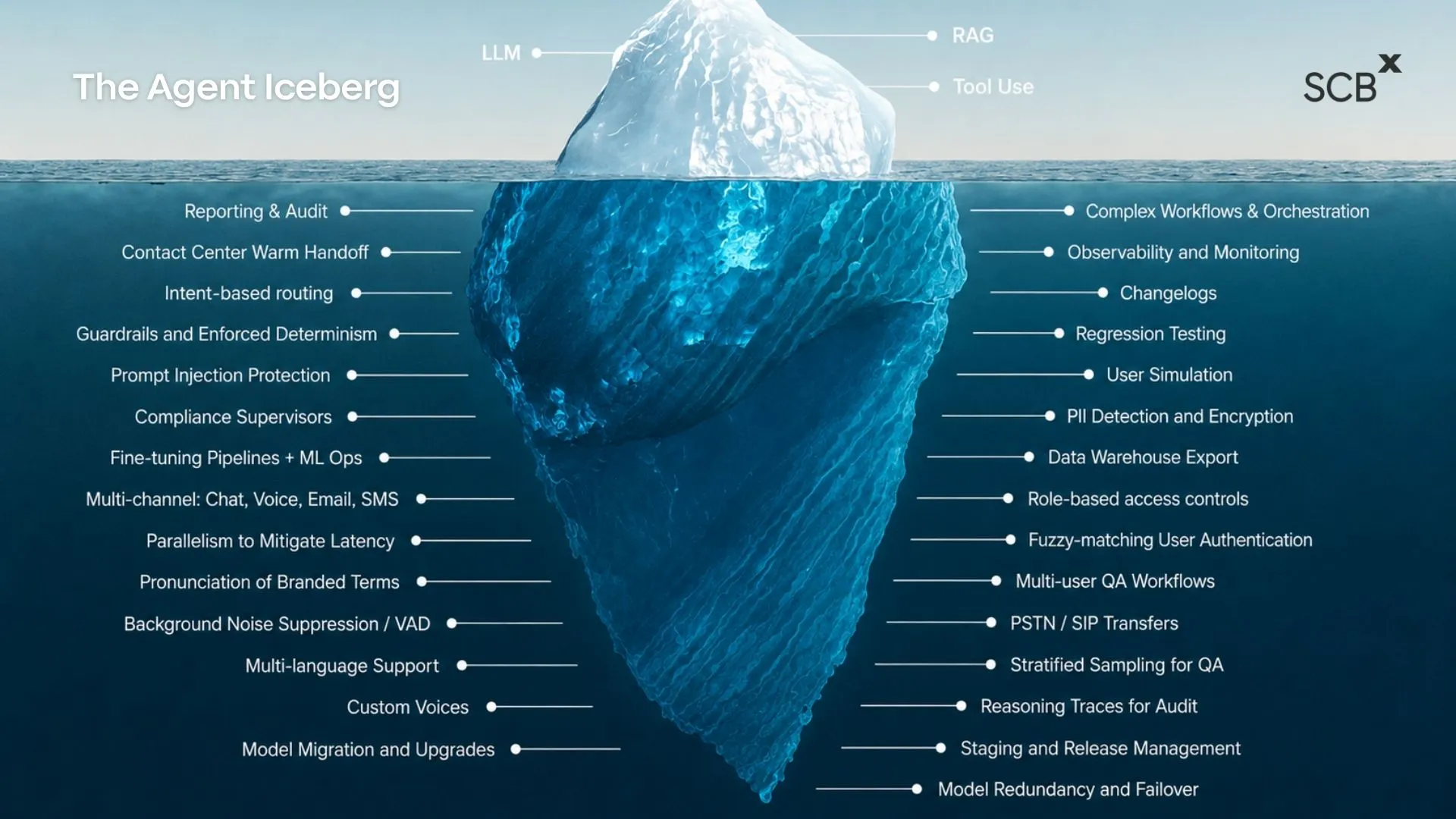
If AI transformation is an iceberg, what sits above the water is what gets most of the attention: LLMs, RAG, tool use, and AI agents. These are the visible faces of AI—the technologies people can see and interact with.
But beneath the surface lies what determines whether AI can actually work at enterprise scale: data integration, security, monitoring, regulatory compliance, access controls, testing, system orchestration, and stakeholder management.
Put simply, getting AI to answer a question is much easier than making it ready for real-world use across a large organization. That is why governance should not be seen as a brake on innovation.
Good governance acts as a guardrail, helping organizations understand what can be experimented with quickly, where the risks are higher, and where additional controls are needed. Because as AI gains more autonomy, one thing becomes increasingly important: customer trust.
The Real Advantage Is Under the Surface
Organizations are no longer competing simply on who can adopt AI the fastest. They are competing on who can build an ecosystem that allows AI to create value continuously—and who knows where to use AI, what to build themselves, what to protect, and how to prepare their people.
AI is the part everyone can see and get excited about. But the real competitive advantage is taking shape beneath the surface—in the parts that are harder to see, harder to showcase, and ultimately what determines whether AI can create lasting advantage for an organization.